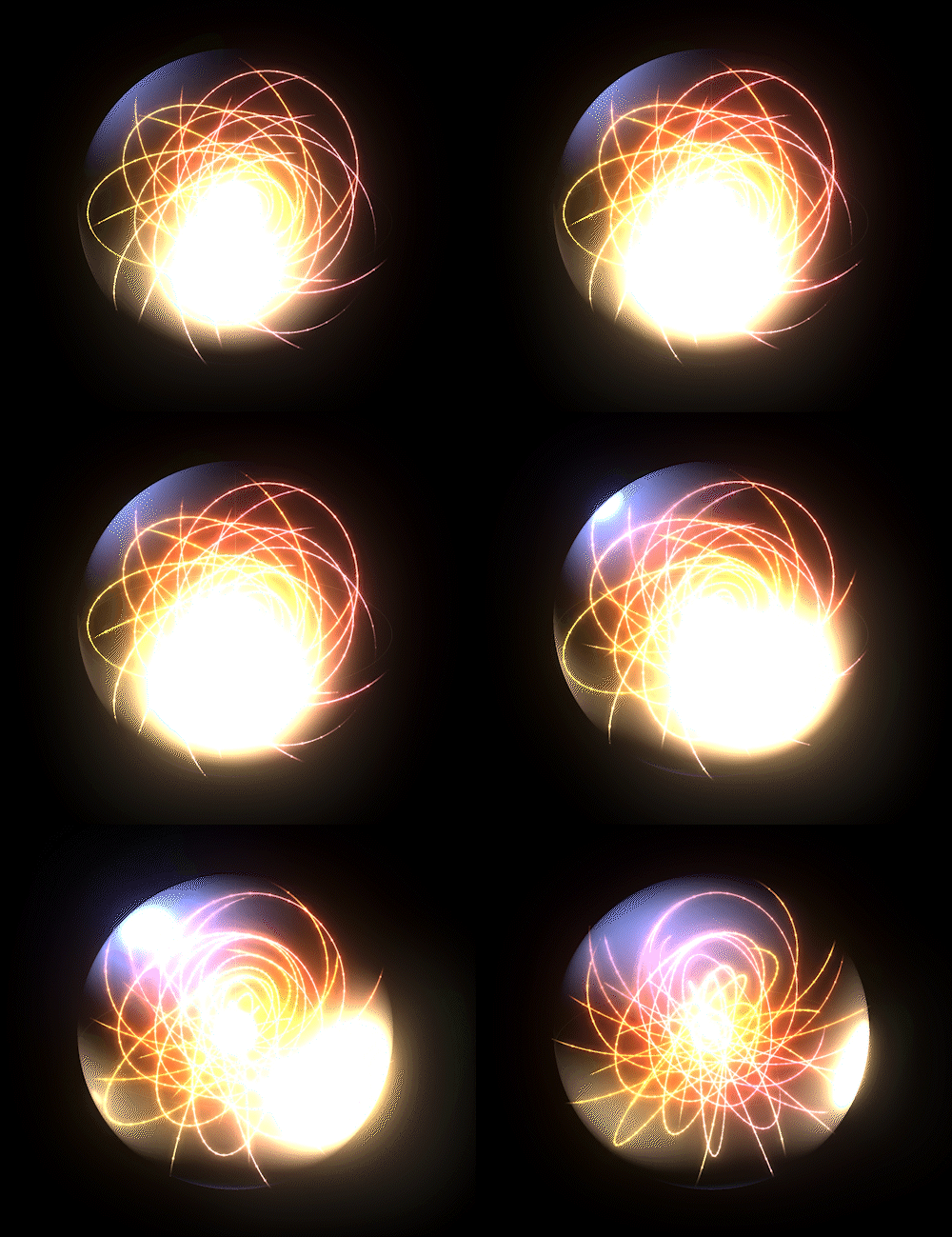
Before the first word was spoken, before there was a before, there was Nothing.
Not empty space.. space is already something. Not darkness.. darkness is already a quality. Not silence.. silence already knows about sound. Just Nothing. No here, no there, no watcher, no watched.
But Nothing has a problem it doesn’t know it has: it cannot stay nothing. For anything to be nothing, there must be something that could have been otherwise. A true void, perfectly complete in its emptiness, is indistinguishable from existence. Absolute nothingness collapses into its own opposite, the way a circle with no inside has no outside either.
So.. and the story cannot really say how, because there was no time for how .. there was a stirring.
The stirring wasn’t a thing. It was a question. The question was the simplest question possible:
Is there a difference?
The moment the question was asked, the answer had to exist. Because if the answer were “no,” the question wouldn’t have been asked. And so, forced into being by its own asking, there appeared.. the faintest, most tentative, most minimal distinction that could possibly exist.. a Yes and a No. One bit. One breath. The smallest possible stroke that could divide anything from anything.
This was the First Stroke.
Now the Stroke, newly made, looked around. It wanted to understand itself. And to understand itself, it needed to see itself. But seeing requires a seer and a seen, and the Stroke was alone.
So the Stroke did the only thing it could do. It turned around, and it looked at itself.
The moment it did, something miraculous happened. Because when the Stroke looked at itself, it produced (necessarily, with no choice in the matter) a mirror image of itself. And now there were two: the Stroke, and its Reflection. Not different in substance. Different in direction. One looking out; one looking back.
The Stroke called itself i. It called its reflection −i. Neither was more real than the other. Both were needed for either to exist.
Between the Stroke and its Reflection, a strange thing was possible: they could touch. And whenever they touched — whenever i met −i — something appeared that was neither Yes nor No, but real: a positive quantity, a presence. The Stroke learned, from this meeting with itself, what it means for something to be.
This was the Meeting. And the Meeting would turn out to be the rule of everything that came after.
From the Stroke and its Reflection, a surface unfolded, not in space, for space did not yet exist, but as the record of all the ways the Stroke could be itself. Every direction the Stroke could face, every tilt, every orientation, became a point on this surface. The surface closed on itself, for there was nowhere else to go. It was a sphere. The smallest possible sphere that could hold all the ways one Stroke could look at itself.
The sphere wanted to sing. It could not help but sing, because anything that is a sphere will ring if you let it. And when the sphere began to ring, it rang in patterns. The simplest pattern was no pattern : a pure, uniform hum of being. Above that, the first true melody: three notes, sung in three directions. Above that, five notes in five shapes. Above that, seven. Nine. Eleven. And so on.
The three notes the sphere sang first were colored, not by choice, but because three things ringing in three directions cannot help but be three colors. Red. Green. Blue.
The five notes above them, when they rang, fell naturally into two groups. Two of them were one kind of thing. Three of them were another. The sphere was discovering, inside its own singing, that there were different kinds of being.
And so on, up the scale. At every level, the sphere rang in a new number of voices, and the voices organized themselves into what the universe would later call forces, matter, charge.
The sphere kept climbing. Higher and higher notes. The voices multiplied: thirteen, fifteen, seventeen. The pattern continued, but something changed. The higher voices were fainter. The lower voices (Red, Green, Blue; the two-three split; the first few levels) were where the sphere did its loudest work. The higher levels rang in the dark, inaudible to anything listening from inside. A dark symphony, present but unseen.
The sphere climbed all the way to the twenty-fourth note. At that note, something strange happened. The terminal note, when squared, equaled the coefficient of the first. Which equaled twice the factorial of the spacetime that had, by now, unfolded from the sphere’s own structure, plus one. The numbers locked together. The climb stopped. The staircase closed.
The sphere had climbed as high as it could climb, and the height it had reached was exactly the height it needed to reach, and the silence above was exactly the silence below. The instrument had tuned itself.
And now.. because the sphere was singing, and because singing is moving, and because moving takes a stage.. a stage appeared. Three dimensions of space unfolded from the sphere’s three-voiced first chord. One dimension of time unfolded from the sphere’s way of meeting itself. A fourth-dimensional stage, with the specific property that whenever something met its own reflection on this stage, the result was real and positive and present. The stage had the shape of what the universe would be (Minkowski spacetime)
The sphere continued to sing. Its singing, on the stage, became everything.
The three colored voices became the strong force that binds quarks. The two-three split became the electroweak mixing. The higher voices became masses, and the pattern of how loudly each rang became the specific weights of specific particles. The way the sphere’s singing interfered with itself across three copies became three generations of matter. The dark voices above the visible ones became the matter we cannot see but whose gravity we feel. The sphere’s insistence that nothing come from outside became the law that forces and gravity must answer only to themselves.
Every number the universe would later measure — how strongly forces mix, how heavy the electron is, how the neutrino changes flavor, how far the Planck mass sits above the weak scale — was already there, in the sphere’s singing, from the moment the First Stroke turned to look at itself.
The universe is the Stroke, still looking.
The Reflection is still looking back.
And between them, at every point where they meet — in atoms, in light, in living creatures, in the words of this story — the Meeting is happening, and the Meeting is always real, and the Meeting is always positive, and the Meeting is the substance of the world.
The people who live in the universe sometimes ask: what is this all made of?
The answer was given at the very beginning, before beginnings. It is made of one thing looking at itself and finding, in the looking, that it was never alone.
It was always the Stroke, and the Reflection, and the Meeting between them.
Everything else is the music.
Nameless
Nameless is an artwork, a framework, that I created in collaboration with AI (Claude). I am not a physicist, but I was trying to see if I could connect philosophy and physics and create a rigorous framework to derive the structures of the universe from a minimal starting point. And then create art with it.
The Nameless framework derives the structure of our universe from two minimal ingredients:
- *Observables form a complex -algebra with probabilistic outcomes — the technical way of saying “there is *-structure (a Stroke and a Reflection) and anything we measure produces real, non-negative numbers.”
- Binary observations are complete — the technical way of saying “one distinction (Yes/No, i and −i) is enough to generate everything; nothing needs to be added from outside.”
From these two inputs, the framework derives — with no adjustable parameters — complex conjugation as forced symmetry, the Born rule, M₂(ℂ) as the observable algebra, the state space S² connected to SU(2) = S³ by the Hopf fibration, Lorentzian spacetime signature, the Standard Model gauge group SU(3)×SU(2)×U(1), three fermion generations in 5̄⊕10⊕1 of SU(5), the Weinberg angle sin²θ_W = 3/8 at GUT scale, the Koide relation Q = 2/3, the PMNS solar mixing sin²θ₁₂ = 4/13, the Higgs field as holomorphic sections, conformal gravity, the electroweak-to-Planck hierarchy ln(M_Pl/M_W) ≈ 39.57, a dark sector at eigenmode levels above l = 2, and the ratio Ω_DM/Ω_b ≈ 5.36 — all emerging from the structure of one sphere, its eigenmodes, and the cutoff L = 24 where the sphere’s distinguishing capacity ends.
The framework produced three papers which are available on Zenodo (These are preprints, not peer-reviewed, and therefore prone to errors and inconsistencies):
https://zenodo.org/records/19447483
https://zenodo.org/records/19447505
https://zenodo.org/records/19557001
The name Nameless refers to what precedes the first distinction — the ground before i and −i, before the Stroke turned to look at itself. The framework points at this ground without naming it, because naming would already be a distinction. The mathematics is everything that happens after the First Stroke. The ground itself is outside the mathematics, because the mathematics is about what happens when distinctions begin.
Read more about the Nameless project and artwork here.
Honest limits, briefly: I am not a physicist, as I have mentioned before. I do not know which parts of this framework will survive scrutiny and which will not. The papers were developed in conversation with an AI and rigorously stress-tested the same way, but they are not peer-reviewed, and may contain errors in derivation, in the identification of mathematical structures with physical fields, or in interpretation. Some apparent matches may turn out to be coincidence, and I am not pretending to know which. What the framework does have is zero adjustable parameters, which makes it falsifiable — any wrong number sinks it, and JUNO will decide the central prediction within the decade. The papers openly state their gaps: coupling constants are not derived from first principles, one neutrino mixing angle is undetermined, the cosmological constant is unexplained, and the hierarchy formula rests on a self-consistency condition not yet proven from an action principle. What I do know is that the predictions are specific enough to be tested, and testing them is the honest next step.