TOR is an alternate numbering system, which I feel closely aligns with philosophy, spirituality, psychology and physics. It re-expresses the current discrete numbering system in a more gradient fashion.
Core ideas:
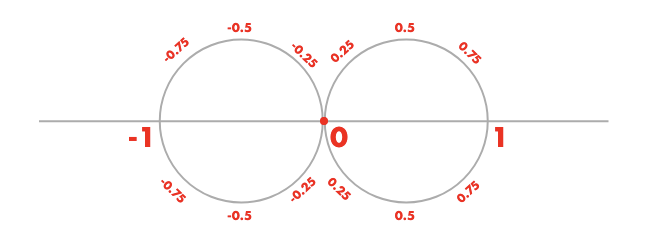
1. There are no discrete numbers; all numbers are gradients.
2. All numbers start from a singularity and end in that same singularity. Just as a wave rises and falls, every number rises to a maximum magnitude and falls back to the singularity.
3. For mathematical purposes, the value of the singularity can be taken as zero; however, it represents a point of infinite potential. As compared to linear maths, here both origin and infinity are the same zero/singularity point.
4. Every time a number rises from the singularity point, its mirror also rises opposite to it so that they balance each other out.
5. There are no independent numbers; all numbers have an equally balancing counterpart at all stages. For notation, these can be considered negative and positive numbers.
6. Although visually represented as separate loops, the loops are part of the same wave continuum.
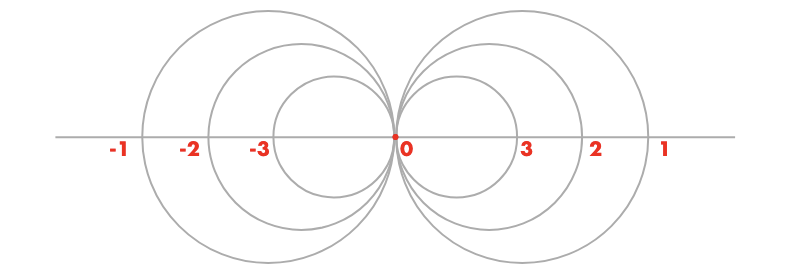
7. The number “1” represents the largest, most expansive loop. Larger integers (2, 3, 4, ..) are smaller loops nested inside the 1, moving closer to the singularity. This suggests that higher numbers are higher frequencies; they are more “dense” or “compressed” vibrations of the original unit. Consequently, the integers 2, 3, 4, etc., function as overtones or harmonics of the primary loop, at the centre of all of which is the same singularity point. The singularity point can thus also be looked at as a recursive gateway/portal to move from one section to the other.
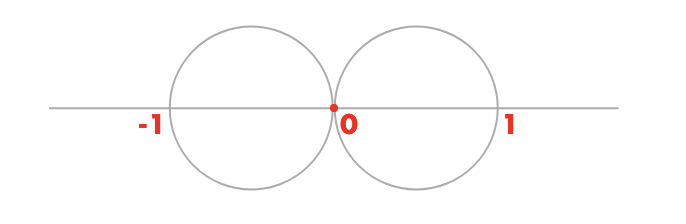
2) Showing the gradation of 1:
3) Showing more numbers:
Philosophical basis:
1. The Principle of Impermanence and Flow
The system posits that everything rises and falls, and nothing is permanent. This aligns with the Buddhist concept of Anicca (impermanence) and the philosophy of Heraclitus, who argued that the universe is in a constant state of flux. In TOR, “value” is not a static destination but a position within a transient cycle.
2. Universal Interconnectedness
The framework assumes that everything is interconnected. This reflects the Holistic view found in various indigenous philosophies and the scientific concept of Quantum Entanglement, where no part of a system can be fully described without referencing the whole wave continuum.
3. The Central Void: Singularity as the Source
Reality is viewed as circular and cyclical, emerging from and returning to an undefinable nothingness or singularity. This mirrors the Monad in Pythagoreanism or Sunyata (Emptiness) in Taoist and Buddhist thought, a “point of infinite potential” that serves as both the origin and the terminal of all existence.
4. The Law of Polarity and Dynamic Balance
The system emphasizes an act of balancing: whatever rises will have a mirror version to balance it out. This is a mathematical representation of the Principle of Polarity from the Kybalion or the Yin and Yang. There are no independent numbers; every value is part of a “mirror” pair (positive and negative) that maintains the equilibrium of the singularity.
5. Vibrational Foundation: The Primordial Sound
All existence is based on waves, fields, energy, or sound. This aligns with the Vedic concept of Nada Brahma (“The world is sound”) and modern String Theory, suggesting that the “particles” we see are actually specific frequencies vibrating within a universal field.